Bhutan

Bhutan

from
Contact Us

Bhutan also referred to as the “Land of the Thunder Dragon”, a small landlocked country nestled in the Eastern Himalayas, is known for its breathtaking landscapes, vibrant culture.

  • Reviews 0 Reviews
    0/5
  • Vacation Style Holiday Type
    Discovery
  • Activity Level Challenging
    5/8
  • Group Size Medium Group
    1 - 30
All about the Bhutan.

Duration: 4 Nights / 5 Days
Location: Paro-Thimpu – Thimphu -Punakha – Punakha – Paro

Bhutan also referred to as the “Land of the Thunder Dragon”, a small landlocked country nestled in the Eastern Himalayas, is known for its breathtaking landscapes, vibrant culture. With rich traditions, Buddhist heritage, and environmental conservation, Bhutan measures its progress not just through economic growth but through Gross National Happiness (GNH), focusing on the well-being of its people and the preservation of its environment and culture.

Bhutan blends tradition and modernity, while ancient fortresses called dzongs, colourful festivals and serene monasteries reflect the deep-rooted spirituality of the Bhutanese people. With over 70% of its land under forest cover, Bhutan is also the world’s only carbon-negative country. Its commitment to sustainability, peaceful lifestyle, and cultural integrity make Bhutan an extraordinary example of how tradition and progress can go hand in hand.

Tour Highlights
• Visit to Tashichoedzong
• Visit to National Memorial Chorten
• The Chimi Lhakhang – the temple of fertility
• Visit to Tiger’s Nest monastery

Note: This is just a proposed itinerary, suggestive of what can be possible in the tour. We customize tours,
according to need. Contact us if you want alterations, and we would help you with a memorable tour

The tour package inclusions and exclusions at a glance
What is included in this tour?Items that are included in the cost of tour price.
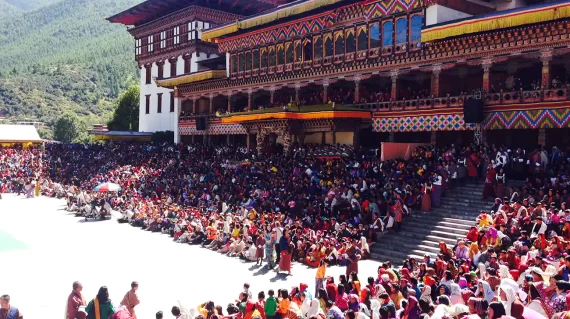
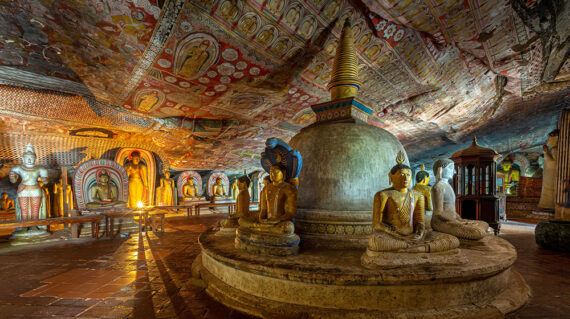
  1. Day 1 Arrive Paro by flight Paro-Thimpu (55 kms / 2 hour drive)

    The flight to Paro is one of the most spectacular in entire Himalayas, the journey offers fascinating views and an exciting descent into the Kingdom. Bhutan’s first gift to you as you disembark from the aircraft will be cool, clean fresh mountain air.

    After immigration formalities and baggage collection you will be welcomed by our representative and drive to Thimphu, the capital town of Bhutan and the centre of government, religion and commerce. Thimphu is a unique city with unusual mixture of modern development alongside ancient traditions. It is perhaps still the world’s only capital city without a traffic light.

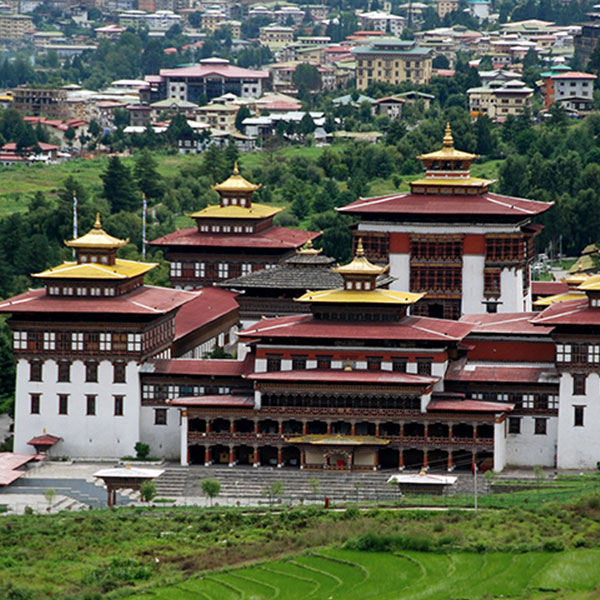
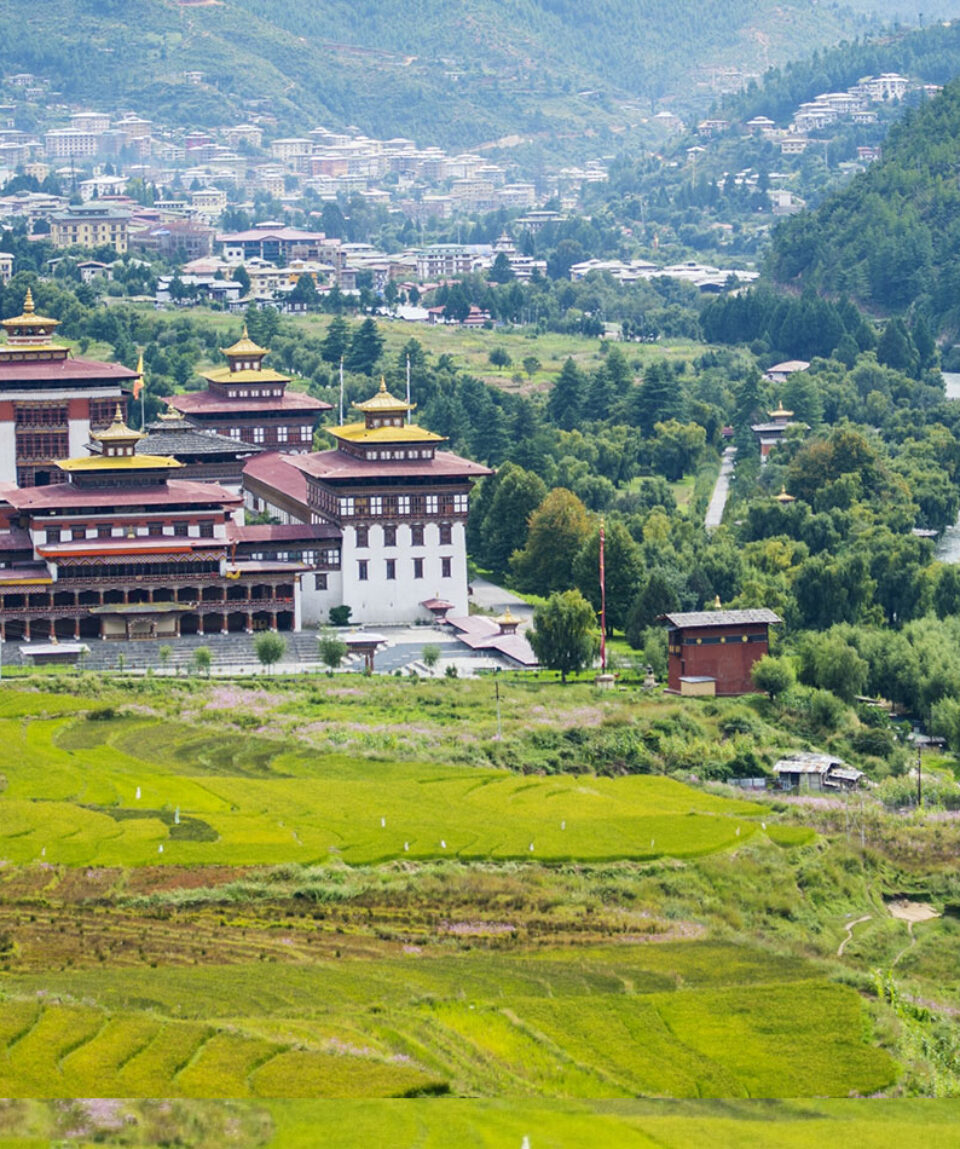
    On arrival, in Thimphu check-into the hotel. Later in the day after checking into hotel, visit Trashichhoedzong, ‘fortress of the glorious religion’. This is the center of government and religion, site of monarch’s throne room and seat of Je Khenpo or Chief Abbot. Built in 1641 by the political and religious unifier of Bhutan, Zhabdrung Ngawang Namgyal, it was reconstructed in 1960s in traditional Bhutanese manner, without nails or architectural plans.

    Afterwards an exploratory walk around Thimphu main street and market area.

    Overnight at the hotel in Thimphu (Altitude 2,320m).

  2. Day 2 Thimphu -Punakha (75 km / 3 hour drive)

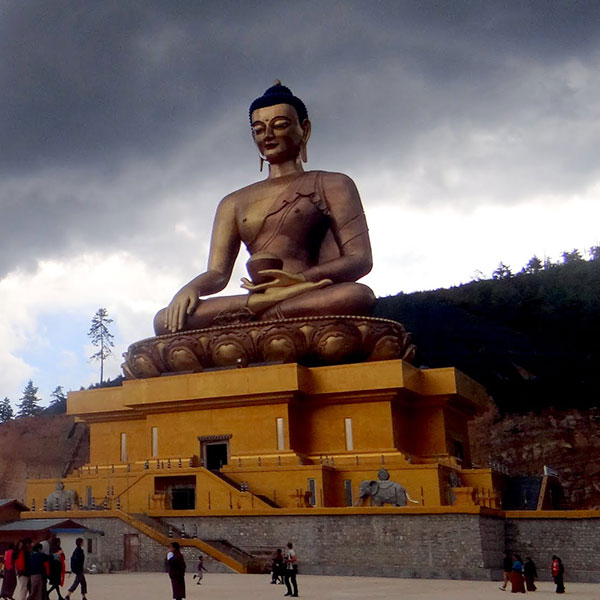
    Morning after breakfast, take a short drive to the north of town to Buddha Dordenma, located atop a hill in Kuenselphodrang Nature Park. The statue fulfils an ancient prophecy dating back to the 8th century A.D that was discovered by Terton Pema Lingpa (Religious Treasure Discoverer) and is said to emanate an aura of peace and happiness to the entire world. This massive statue of Shakyamuni made of bronze and is gilded in gold, measures 51.5 meters in height, making it one of the largest statues, in Bhutan. 125,000 smaller Buddha statues have been placed within the Buddha Dordenma statue, each of these also have been cast in bronze and gilded.

    Visit Changangkha Lhakhang – fortress like temple and monastic school perched on a ridge above Thimphu. The temple was established in 12th century on a site chosen by Lama Phajo Drugom Shigpo, who came from Tibet. The central statue here is Chenrezig in a manifestation with 11 heads. From temple courtyard, there is fascinating view of Thimphu valley.

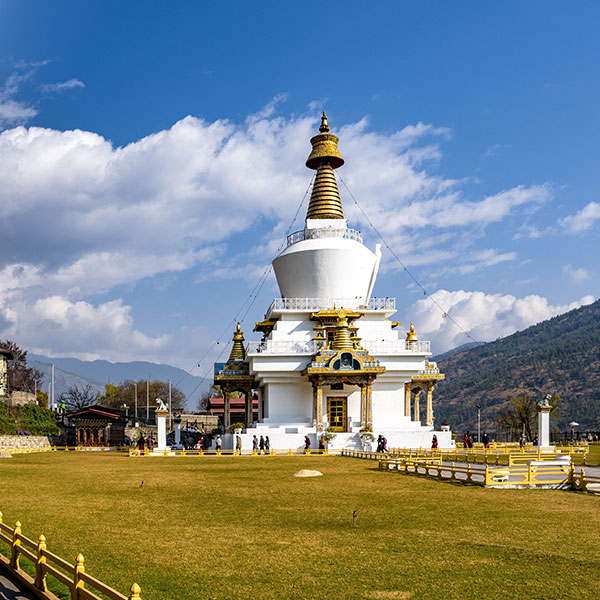
    visit National Memorial Chorten, a large white structure crowned with a golden spire. This is the most ideal spot to interact with locals who throng in large numbers to circumambulate the chorten, whirl the large red prayer wheels and pray at a small shrine inside the gate. The paintings and statues inside the monument provide a deep insight into Buddhist philosophy.

    Afterwards drive up to Dochu-la pass (3,088m / 10,130 ft) stopping briefly here to take in the view and admire the chorten, mani wall, and prayer flags which decorate the highest point on the road. If skies are clear, the following peaks can be seen from this pass (left to right): Masagang (7,158m), Tsendagang (6,960m), Terigang (7,060m), Jejegangphugang (7,158 m), Kangphugang (7,170 m), Zongphugang (7, 060 m), a Table Mountain that dominates the isolated region of Lunana – finally Gangkar puensum, the highest peak in Bhutan at 7,570m.

    At Dochula Pass, 108 chortens or stupas known as Druk Wangyal Chortens have been built by Ashi Dorji Wangmo Wangchuk, the eldest Queen Mother. These chortens are built in three layers, the first lowest level layer has forty-five chortens, the second has thirty-six and the top layer has twenty-seven, built around the main chorten.

    Then proceed onward to Punakha, which served as the capital of Bhutan and seat of government until 1955 and still it is the winter seat of Je Khenpo (the chief abbot). Blessed with temperate climate and owing to its natural drainage from Pho Chhu (male) and Mo Chhu (female) rivers, the fertile Punakha valley produces abundant crops and fruits. Located at an elevation of 1300m above sea level, Punakha enjoys mild winters and is popular year-round destination.

    On arrival check into hotel.

    Evening take a stroll in and around Punakha town.

    Overnight at the hotel in Punakha (Altitude 1,300m).

  3. Day 3 Punakha - Paro (125 km / 4-hour drive)

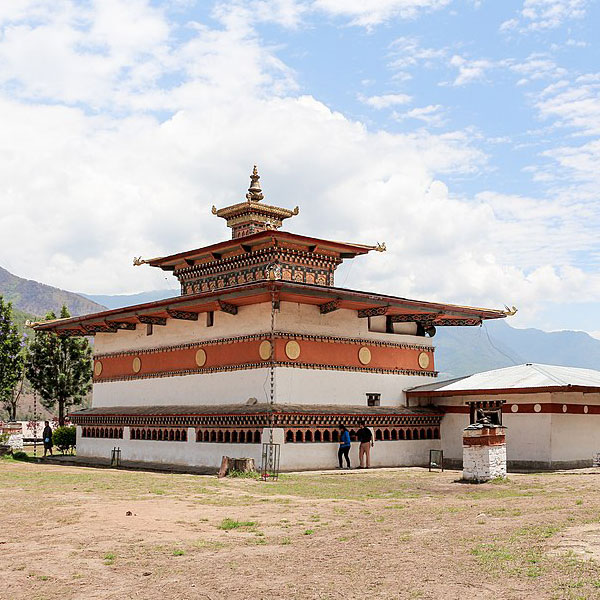
    After breakfast, a short excursion to Chimi Lhakhang.

    The Chimi Lhakhang, also known as the temple of fertility. It is widely believed that couples who do not have children and wanting one, if they pray at this temple, they are usually blessed with a child very soon. The trail leads across rice fields to the tiny settlement of Pana, meaning ‘field’. A walk through the village near the temple will give you rare glimpses into the daily life and lifestyle of the villagers.

    visit Punakha Dzong or ‘Palace of Great Happiness’, built at the junction of the Phochu and Mochu rivers in 1637 by Shabdrung Ngawang Namgyal. This majestic dzong served as both the religious and the administrative centre of Bhutan in the past. It measures some 600 by 240 feet and has a six-story, gold-domed tower. Inside are courtyards and religious statuary that hint at the depth of history and spiritual tradition embodied here. Your guide will illuminate your understanding of this intricate culture that is exotic to us, though long established here.

    Drive to Paro along scenic highway.

    En-route stop to visit Simtokha Dzong: handsomely proportioned Simtokha Dzong was built in 1629 by Zhabdrung Ngawang Namgyal. Officially known as Sangak Zabdhon Phodrang (Palace of the Profound Meaning of Secret Mantras), Simtokha is often said to be the first dzong built in Bhutan. It is in fact also the oldest dzong to have survived as a complete structure. Its utse (central tower) is three storeys high and prayer wheels around the courtyard are backed by more than 300 finely worked slate carvings.

    The beautiful valley of Paro encapsulates within itself a rich culture, scenic beauty and hundreds of myths and legends. It is home to many of Bhutan’s oldest temples and monasteries, National Museum and country’s only international airport. Mount. Chomolhari (7,314m) reigns in white glory at the northern end of the valley and its glacial water plunge through deep gorges to form Pa Chhu (Paro River). Paro is also one of the most fertile valleys in the Kingdom producing a bulk of the locally famous red rice from its terraced fields.

    Overnight at the hotel in Paro. (Altitude 2,280m).

  4. Day 4 Paro

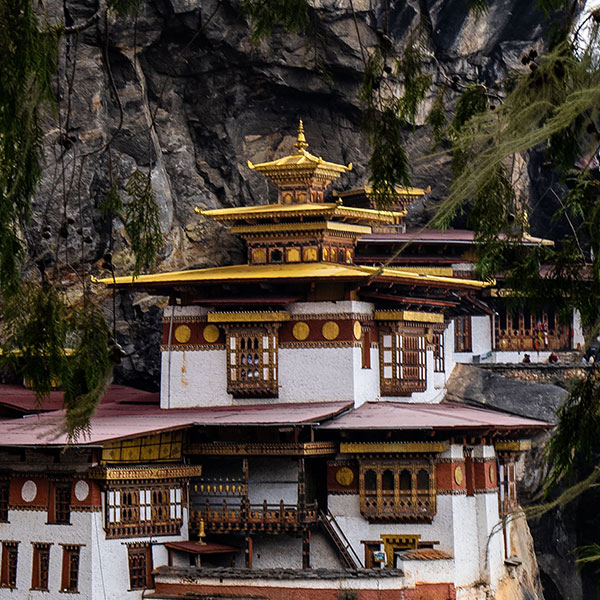
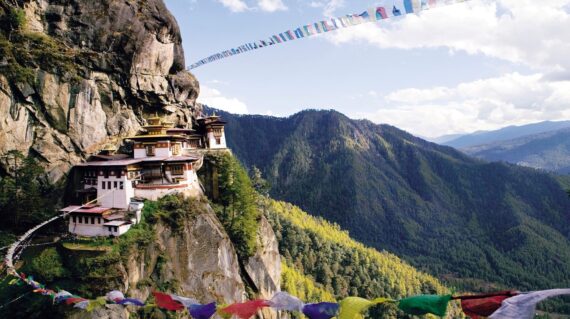
    After breakfast, embark on a fascinating excursion to Taktshang Monastery or Tiger’s Nest (approx. 5 hours round trip up hill walk). It is one of the most famous of Bhutan’s monasteries, perched on the side of a cliff 900m above the Paro valley floor. Legends say that Guru Rinpoche arrived here on the back of a tigress and meditated at this monastery and hence it is called ‘Tiger’s Nest’. This site has been recognized as a most sacred place and visited by Zhabdrung Ngawang Namgyal in 1646 and now visited by all Bhutanese at least once in their lifetime.

    Late afternoon, drive end of the Valley to newly restored Drukgyel Dzong. Built by Zhabdrung Ngawang Namgyal in 1646 to commemorate an early military victory over Tibetan invaders, the dzong name means, indeed, ‘victorious Druk’. Historically and strategically, this Dzong withstood all its glory and was featured in 1914 vide National Geographic magazine. The glory of Drukgyel Dzong remained even when it was destroyed by fire in 1951. On a clear day, one can see the commanding view of Mount. Chomolhari (7,314m) from the village, below the Dzong.

    On the way back to town stop en route to visit Kyichu Lhakhang: It is one of the oldest and most sacred shrines of the Kingdom dating back to 7th century (the other is Jambey Lhakahng in Bumthang). The lhakhang complex is composed of two temples. The first temple was built by Tibetan King, Songtsen Gampo in the 7th century and in 1968, H.M. Ashi Kesang, the Queen Mother of Bhutan, built the second temple in original pattern.

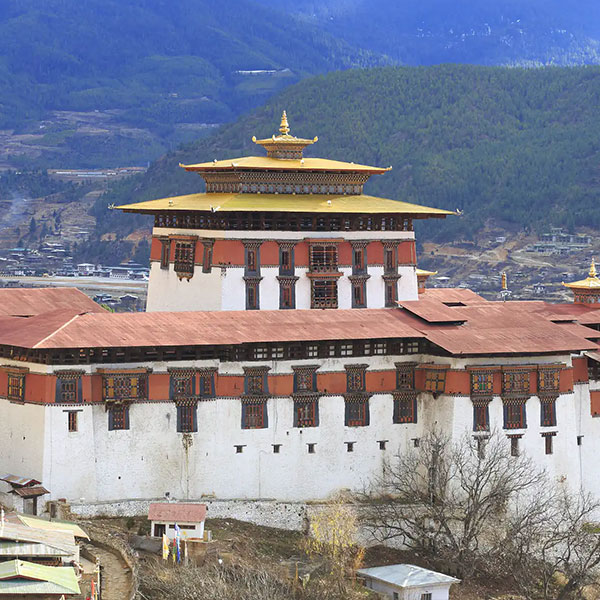
    (Time permitting) also visit Rinpung Dzong (Paro Dzong), meaning (“fortress of the heap of jewels”), which has a long and fascinating history. Along the wooden galleries lining the inner courtyard are fine wall paintings illustrating Buddhist lore such as four friends, the old man of long life, the wheel of life, scenes from the life of Milarepa, Mount. Sumeru and cosmic Mandala.

    Overnight at the hotel in Paro (Altitude 2,280m).

  5. Day 5 Depart Paro

    After breakfast, transfer to the airport for flight to onward destination.

bhutan
Bhutan tradition
Buddhist heritage.